Scientists develop new model to simulate Antarctic ice shelf collapse
Nicolas Dettling, British Antarctic Survey
The collapse of Antarctica’s Larsen B Ice Shelf in 2002 is one of the clearest examples of how rapidly ice shelves can disintegrate. Researchers believe the process begins when excessive surface melting saturates air pockets in the snow layer that normally absorbs meltwater. Water then pools on the ice surface, seeps into cracks, and weakens the shelf until large sections break apart. Climate projections suggest that under strong warming scenarios, several Antarctic ice shelves could become vulnerable to similar collapse within decades, raising concerns about the stability of glaciers that hold vast quantities of ice capable of driving significant sea-level rise.
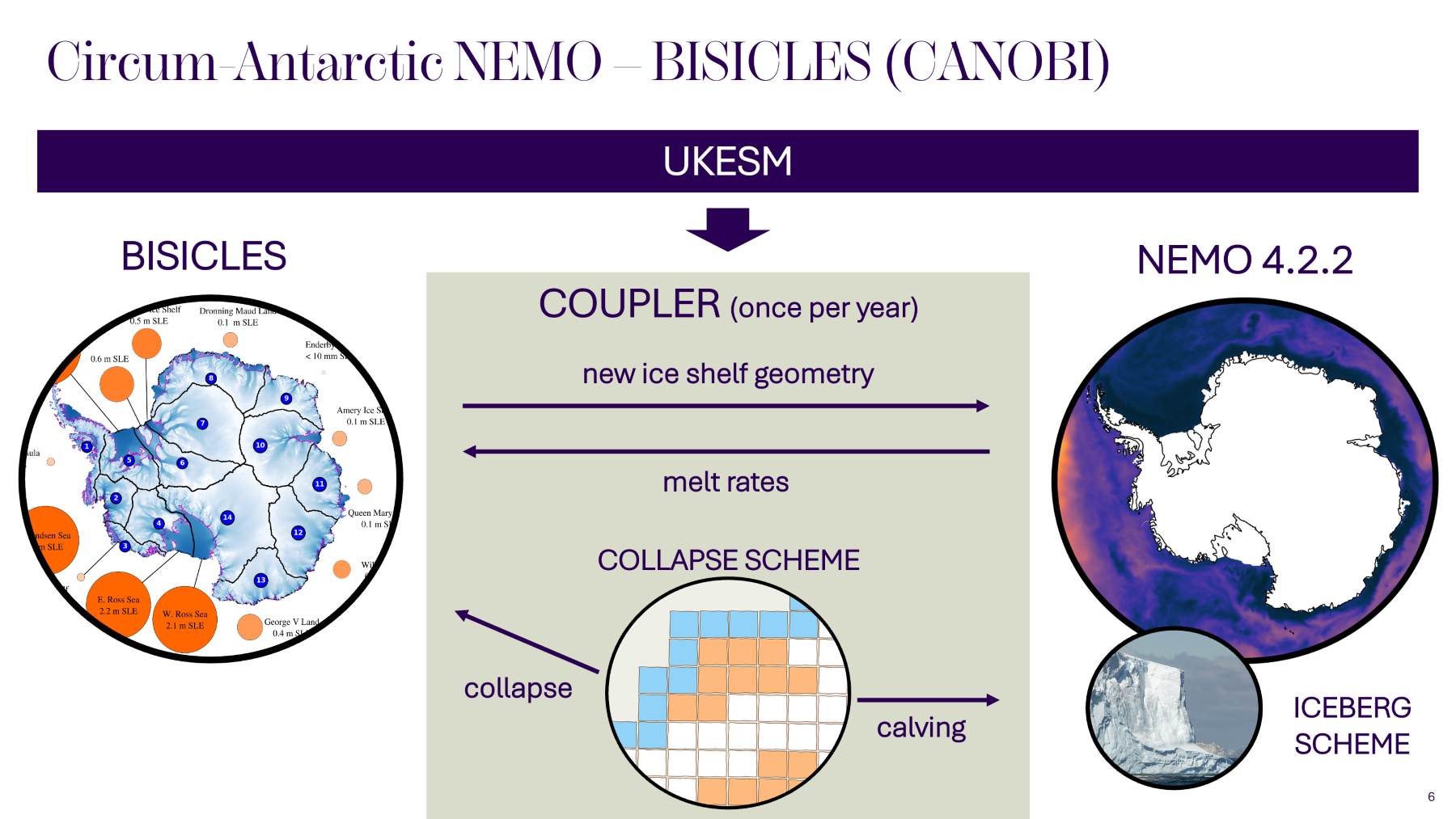
To better understand these risks, researchers have developed a new high-resolution modelling system called CANOBI, which couples ocean and ice-sheet models so that both the shape of ice shelves and the surrounding ocean can evolve together. Unlike many existing climate models, the system can simulate changing ice-shelf geometry and the effects this has on ocean circulation and melting. Early tests show that the model responds realistically to changing conditions and can capture interactions between warming ocean waters and retreating ice shelves.
The next step is to incorporate ice shelf collapse directly into the model. New simulations will identify shelves at risk based on sustained surface melting, then remove vulnerable sections to study the consequences for Antarctic ocean circulation, sea ice formation, glacier flow, and future ice loss. This work represents an important step towards understanding how Antarctic ice shelves may respond to climate change and how their collapse could affect future sea-level rise.